


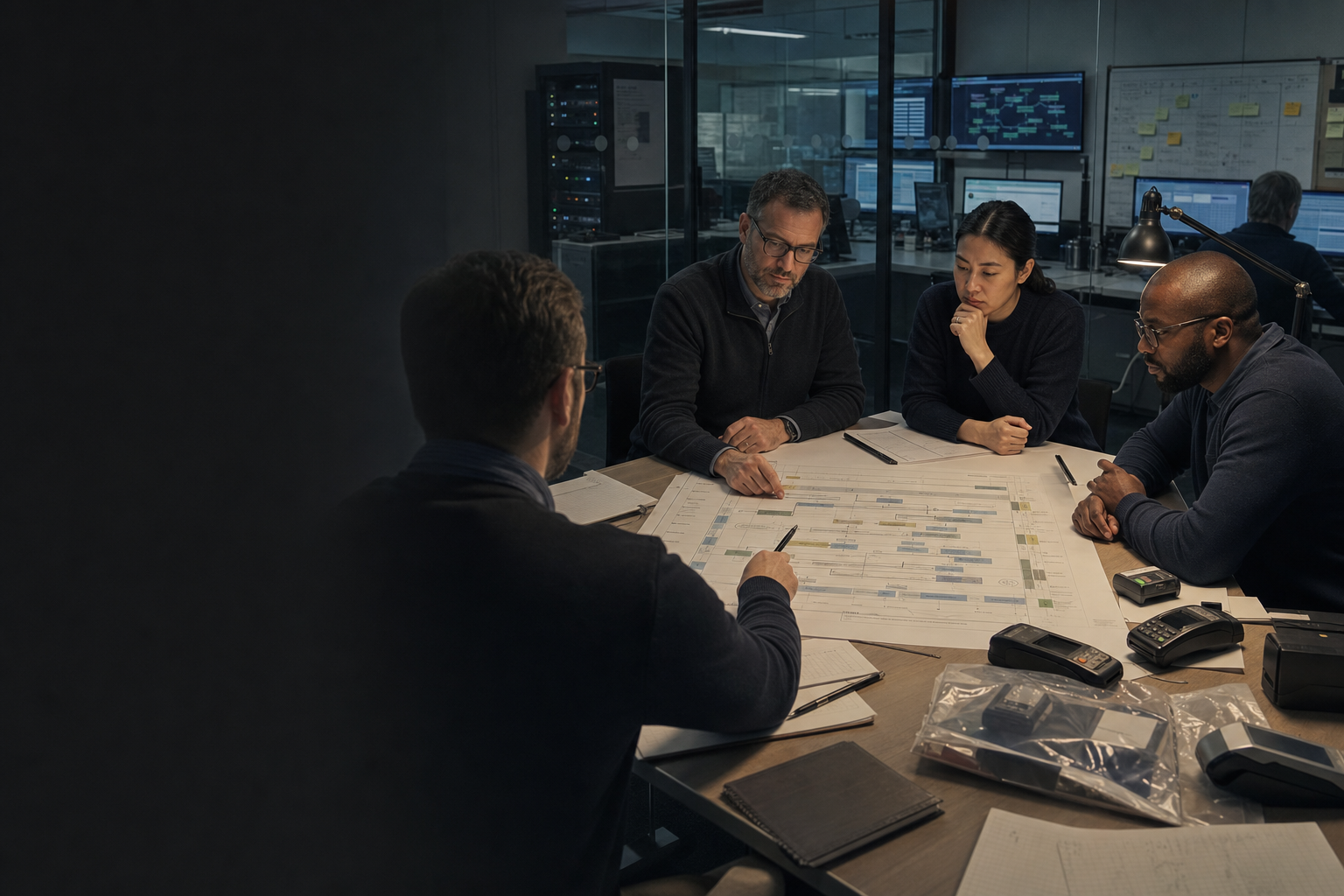
Technology practitioners reviewing a physical enterprise systems map

Skymind Solutions

Make complex technology change operable.

Connect architecture, engineering, data, security, and delivery around the systems your organization must change—and continue to run.

A practical route from difficult decisions to owned systems.Architecture with consequencesDelivery with operating contextChange through evidenceOwnership beyond release

Ways to engage

Start with the system pressure, then assemble the capability.

Move from a difficult decision to a delivered and owned system without separating advisory, engineering, and operations.

Operating contexts

Technology choices change with the environment around them.

Begin with the people, controls, information, physical conditions, and continuity needs that shape the system.

Explore industry contexts
01

Regulated services

Sensitive information, controlled decisions, accessible journeys, and long-lived accountability.

02

Connected operations

Physical work, event flow, field constraints, partner boundaries, and operational continuity.

03

Essential infrastructure

Distributed platforms, public outcomes, remote assets, service reliability, and lifecycle risk.

Illustrative scenarios

See how a difficult system change can be made governable.

These are transparent working scenarios—not client claims—showing decisions, boundaries, transition, and ownership.

Illustrative finance technology environment
FinanceIllustrative engagement

Modernizing a Financial Platform Without a Big-Bang Cutover

A regional financial institution depends on a tightly coupled application estate for customer servicing, transactions, reporting, and operational controls. Release dependencies make even contained changes difficult to test and schedule.

Illustrative resultSequencedModernization is organized into bounded capability transitions with explicit dependencies and decision gates.
Illustrative resultTraceableTransaction, control, data, and consumer evidence remains visible through validation and cutover.
Illustrative resultRetirableEach increment includes a decision and work path for removing the legacy behavior it displaces.

Explore the scenario
Illustrative healthcare technology environment
HealthcareIllustrative engagement

Building a Governed Clinical Operations Data Foundation

Clinical and administrative teams rely on information from multiple systems with inconsistent identifiers, definitions, freshness, and access rules. Analysts spend time reconciling data before they can discuss operational decisions.

Illustrative resultGovernedAccess, meaning, quality, lineage, and lifecycle responsibilities are attached to priority data products.
Illustrative resultObservableFreshness and quality issues can be seen before they silently reach operational reporting.
Illustrative resultUsableMeasures are organized around real operational questions with definitions and limitations in context.
Explore the scenario
Illustrative manufacturing technology environment
ManufacturingIllustrative engagement

Connecting Production Quality Signals Across Plant Systems

Production-quality evidence is distributed across line equipment, operator observations, inspection tools, historians, and enterprise systems. Timing and identifiers make it difficult to trace a signal to the product and decision it affected.

Illustrative resultConnectedProduction and quality signals share explicit identity, event meaning, ownership, and recovery behavior.
Illustrative resultReviewableOperators retain authority and can inspect evidence, record exceptions, and challenge analytical output.
Illustrative resultTraceableA quality decision can be followed from equipment signal through data processing and final disposition.
Explore the scenario

Decision notes

Practical questions for leaders accountable for long-lived systems.

Read all decision notes